Friday, July 13, 2018

Nostalgia and Invisible Racism

Nostalgia and Invisible Racism

The title of this exhibit weaves three threads of thought. On one thread I was thinking about invisibility and race. I read, and copied onto handmade paper the text of the novel ‘Invisible Man’ by Ralph Ellison, about the many ways a black man can be rendered invisible in society.  Another thread was about racism invisible to the ones who hold it.  They either deny that it exists in them or really don’t see it.  The third thread was about nostalgia, the kind that looks back on pleasant memories while overlooking brutal history and racial injustice.  Nostalgia in the white South is a feature that is familiar to me.

I look back fondly on family dinner table arguments.  I valued our ability to talk about issues of the time even though they contained sentences like “society is not ready for integrated swimming pools yet”.  I could disagree without feeling the kind of despair and outrage that I feel today over yet another black body shot or incarcerated. Can the one be implicated in the other?  Does nostalgia contain an abeyance of responsibility?

I look back to memories like watching heavy rain through dark green trees surrounding my grandmother's screened porch in Atlanta. In a drawer somewhere is a letter proudly describing a long ago cousin who rode with the Red Shirts and how he raced on horseback to vote in three different polling places to help install Wade Hampton as governor of South Carolina in 1876.  Both of my parents were born and brought up in South Carolina. My great grandmother’s sisters sewed for the Red Shirts.  I grew up with these stories.

The work of this exhibit uses paper I made from the pulp of my grandmother’s journals.  The text of ‘Invisible Man’ pushes its way into this paper toward an undulating water stain. On the opposite wall more papers hang from a tatted thread. They are weighted with small scrolls bearing texts of South Carolina slave narratives. The wistful beauty of the paper bears scars barely hinted.  Much hangs in the balance.


detail, from chapter 4

Artist Statement, as mounted in the exhibit.

The soil of South Carolina has a place in my soul. To make peace with the South and my whiteness I have dug into layers of sentimentality tilled into the garden of family stories. Nostalgia can be dangerous. The sentimentality of the “Lost Cause” blurred the brutal foundations of the Southern economy. I think of a great great-grandfather who farmed the soil of the old South. I think about the soils of land and property, ownership of land and ownership of human beings. I conflate the words ‘soil’ and ‘soul’ in a reflection of the tangle of affections and cruelties embedded in the heritage of the American South. My emotional landscape with regard to my family’s legacy is fraught with contradictions just as America’s landscape is fraught with injustices. Healing will require tilling through thick layers of white nostalgic sentiments and turning under ingrained crops of racial animus. We must explore the present character of racist thinking before we can grow new crops and new possibilities.


‘INVISIBLE MAN’ Series

Text from Ralph Ellison's "Invisible Man" is written to the edge of a water stain on paper made from a southern matriarch's pulped journals

The Southern heritage is mine.  The journal shreds in the paper are my grandmother's.  The inherited repercussions of slavery and racism belong to America as a whole.  .


"Uncle Mad"  detail


The note, in my grandmother's handwriting, reads:

From the left Ann, Libby, Kitty Lewis, "Uncle Mad",  Billy & Robert Lewis.
In the back of Uncle Mad is our cook's (Clara Johnson) brother Tom (I think) who helped in the garden.
We were listening as Uncle Mad (age ?) played the accordion and told us about being born a slave & who were the kind masters and who were not.


'Prayers and Debts'

The little hanging scrolls each represent one of the 285 slave narratives collected in South Carolina during the Works Progress Administration’s Writers Project in the late 1930’s.


Friday, July 6, 2018

Roots


ROOTS 
Paper Circle  Nelsonville, Ohio  Mar./Apr. 2016

Plants take center stage as I explore cultural roots and dig into the organic nature of life.

As a papermaker I always enjoy using fibers from a plant I have harvested myself.  Its proximity to the soils I stand on offers special resonance. I was offered an opportunity to make paper from an okra crop on my neighbor’s farm in North Carolina and I spent lovely hours harvesting.

The okra plant itself has a quirky resonance with my own family roots in South Carolina. When I first learned how to make paper years ago, I embedded an okra root in a paper artwork. I called it “a root for my grandmother” because she had told her daughter, my mother, that in moving all over the place the way Army dependents do, she was raising rootless children.  At the time I made the work I was being a little flippant. But some underlying reverence led me to treasure this gestural paper for years.  I do still wonder what makes good roots?

Paper is a loaded medium, I think of books, literature, and art, but paper also references ordinary cultural objects like cardboard and toilet paper and so much more. I love the metaphorical richness of paper. My passion for papermaking is intimately connected to plants and natural processes, and to paper’s role as a medium of human expression.

This exhibit is a ‘sketchbook’, prompted by an exploration of okra fiber and a renewed focus on my own generational roots in the South. I wonder what makes strong cultural roots. In this age of migration, how do people care for their cultural nourishment? 


'A Root for My Grandmother


Okra as a formation aid.

In Japanese tradition methods of papermaking
a substance is added to the vat to slow down drainage.  The papermaker has time to form a
smooth and evenly dispersed sheet of paper,
hence the term 'formation aid'.

Formation aid is traditionally made from the
root of a plant called taroro aoi. It's Latin name
is Abelmoschus manihot, in the mallow family,
Malvaceae.  It is closely related to our familiar
okra, Abelmoschus esculentus.

The tendency of okra to be viscous and slippery can also be used to good effect in forming a sheet of paper. Here I have soaked some frozen okra and am squeezing the thickened water into my vat. The wet sheet on the screen is made of okra fiber.


 'A Butterfly Effect'

Okra root, thread, and paper.


A butterfly effect in physics is a phenomenon
where a small variation in one area of a complex system can have larger effects elsewhere.
The title for this piece happened for the simple reason that the root that is painted black hangs from a butterfly clip.

In 'A Butterfly Effect'  I have used paper as a personal anchor, tenuous as that might be. 
It is a fragile, suspended moment like my feeling of rootlessness. The one floating page was made of pulped journals.  The other has a curved line of journal text emerging from an ink blot.  Inked threads spill from a brush visually connecting the two.


The larger effects within a complex world are still playing out.

Thursday, July 5, 2018

Okra Festival - Burkville, Alabama - 29 Aug. 2015


Okra Paper
August 29, 2015 I went to an Okra Festival in Burkville, Alabama, a small community in Lowndes County.  I went with my neighbor Judy Lessler the owner of Harlands Creek Farm.  We were both interested in okra.  She was interested in okra's history in the South and its origin as a crop brought from Africa along with the slave trade.  Okra connected the two of us to the loaded history we share as white southerners.

I offered to make paper from okra bast fiber to take with us. I spent the preceding fall, after the okra plants had dropped their leaves, harvesting the stalks.  I stripped the bark for cooking and cleaning, pounded the inner bark into pulp which formed a lovely yellowish paper. I made a darker grayish paper from bark fibers whose brown outer layer had not been cleaned away.  Paper is made of cellulose, found in the inner bark, the phloem.  The outer bark added dark flecks to the paper and darkened the final sheet.


Here is the hefty harvest, almost more than I could deal with by myself, which is why I left some of it with its brown bark still clinging.   


The well cleaned bark made lovely light paper.


Okra Festival


Loree making okra paper
'Loree'   .. collage on okra paper

Wednesday, June 11, 2014

Table Intimacies

TABLE INTIMACIES
ArtSpace Raleigh 2-31 May 2014

Statement:

A table is an ordinary object. Powerful stories are built on bedrock ordinary. 

Economic engineers today use the “kitchen table” as a metaphor to refer to the personal household economies of daily life. Without those personal efforts all of their engineering would be moot.

The dinner table, the banquet table, the conference table….all are sets and stages for stories.  The stories I want to bring to the table are those of unheralded labor – the patient toil of flax and cotton harvesters, the skill of the weaver, the woodworker, the artistry of designers, and the never-ending care and labor of those who are responsible for the food on the table.

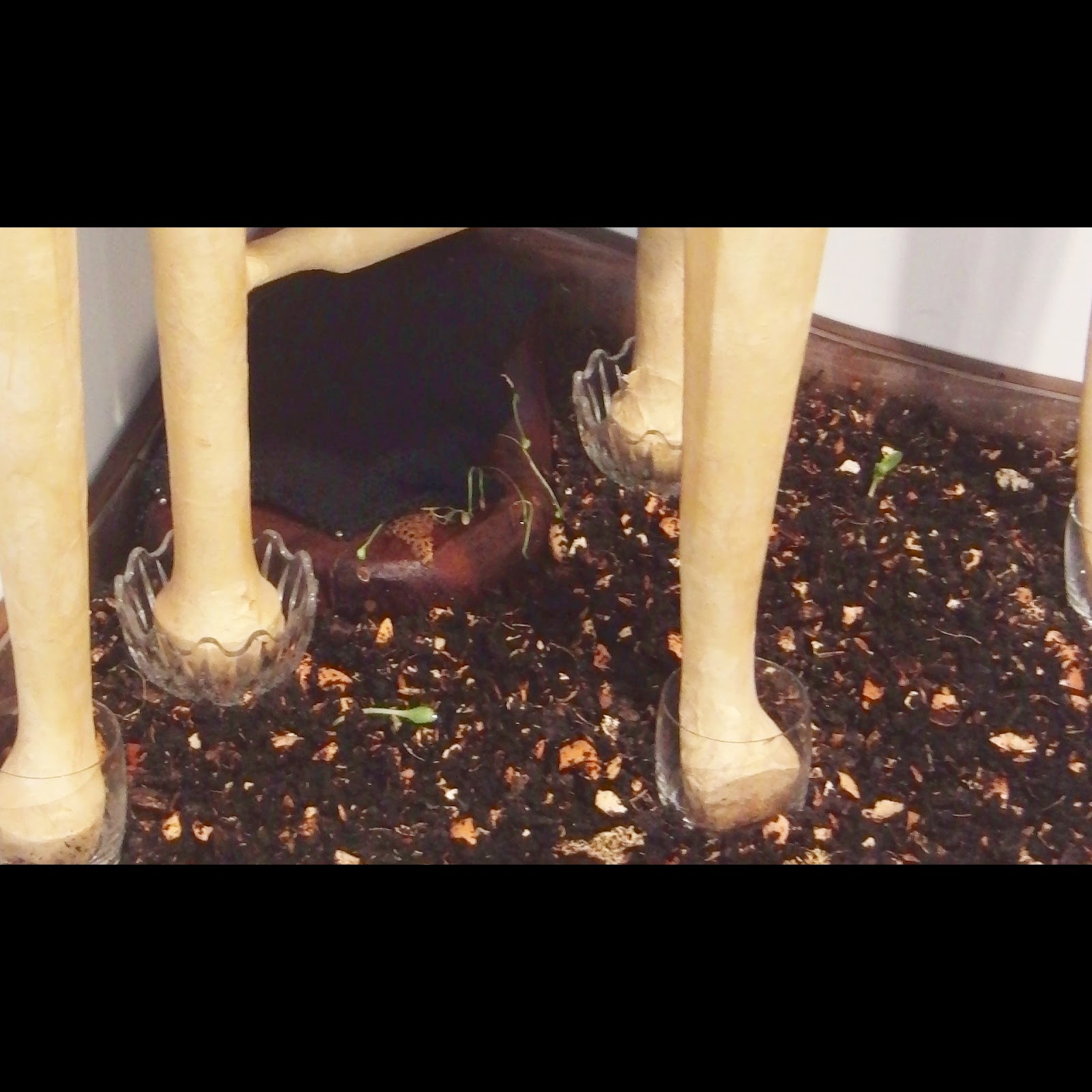
My collaborator in this exhibit is a worm (actually lots of them), Eisenia Fetida, the red wriggler. 

Beneath our feet is a universe of soil.  Microcosms of flora and fauna tend to the richness of life. Their daily labor goes mostly unheralded.  Ordinary as dirt. 


Ann Corley Silverman


Sacred Table -


Table and Cloth -


process…..


Breakfast with Cantalope - more images and information about this piece can be found in another blog entry in 2013.  Situating Food - Food for Thought


Souls of Plants -  the brown 'lace' of the tree form is cantaloupe rind after worms had been working.


Thursday, December 26, 2013

Mischief in the living room

drawing by Eleanor Beard Hatton
I spent some time on Christmas day thinking about my great-grandmother, who spent a lot of time thinking about love.

Monday, October 28, 2013

Two works from the Columbus Metropolitan Library 2013

Art Unbound: an invitational   Oct.21-Nov.21 2013  

"CARBON"

My daughter, Elena, collected a bin full of books from the library loading dock that were destined for recycling.  I couldn't be there to get them myself.  I had had an idea and I asked her for some hard bound editions, roughly the same size, and she gathered all the Reader's Digests (among many other books).
https://www.youtube.com/watch?v=FaW8tzo9iWg

Those editions were destined for an experiment at turning books into bio-char.  Bio-char is a way of using charcoal, by grinding it up and digging it into the soil, to improve the soil's nutrients and its ability to retain moisture.  It is a way of recharging the earth so that the carbon of life can be productively reused.  It seemed right to me that if trees give life to these pages of our cultural wealth then we should return those pages to the soil for new wealth.  The work is called "Carbon".  Though I know that burnt books have emotional impacts well beyond their constituent materials it is a recognition of that shared constituent that I am after.


"PEBBLED VOLUME"

The first book I worked on, from the crate of books my daughter brought me, was a hard bound edition whose size, shape, and content called to me.  It's title "Inside the Third Reich" promised so many emotionally conflicting themes.  Could I make it into an object of quiet reflection on the passage of time and the possibility of wisdoms gained?  I must thank my daughter, who identifies as Jewish though I do not, for her thoughtful gathering of materials for me to use for this show.  This was an opportunity to think about contemporary violence in the world and Albert Speir's warning about the danger of individual power, especially combined with the exponentially more lethal weaponry that technology has placed in our hands.  Time and a river's pebbling of rock point to a gentler way of shaping the shards of our angers.


Situating Food / Food for Thought


Banvard Gallery October 9 - December 31, 2013
Knowlton School of Architecture, The Ohio State University

The flesh of the cantalope is gone.  Only the lace of its rind remains.
The worms are gone.  Only traces of their meal and their presence remain.

Handmade paper with cotton placemats, sewn to wood panel, plexiglass,
and polished walnut frame.